A Deck That Feels Solid
Should Actually Be Solid
Soft spots, sags, and a deck that flexes when it shouldn’t are structural problems — and they don’t go away on their own. We assess the framing, identify the root cause, and make the repairs that restore your deck’s integrity from the ground up. Posts, joists, beams, ledger boards — we handle all of it.
Get a Free Structural Assessment
Describe what you’re noticing and we’ll schedule a free on-site visit. No obligation.
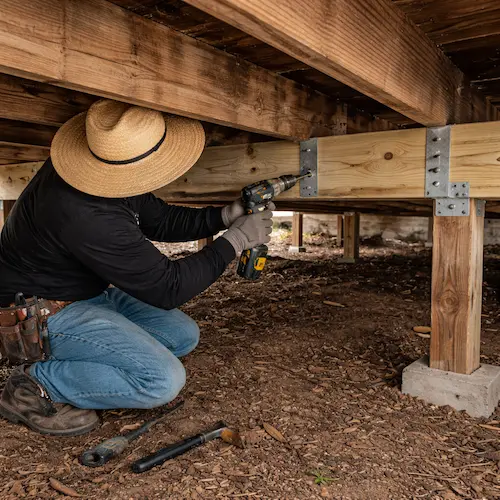 Structural Repair
Surface Problems Are Easy to See. Structural Problems Are What Matter.
A deck’s surface condition tells you something, but the framing tells you everything. The posts, beams, joists, and ledger board are what actually hold the deck up and keep it attached to your home. When any of those components fail — through rot, improper installation, insect damage, or just years of stress — the deck becomes unsafe regardless of how the boards on top look.
Structural repairs are more involved than board replacement, but they’re almost always less expensive than a full deck tear-out and rebuild. We assess what’s failing, repair or replace the specific components that are compromised, and leave the rest of the deck intact. The goal is a safe, stable deck — not an unnecessary demolition job.
- Post, beam, and joist repair and replacement
- Ledger board assessment and repair
- Footing inspection and correction
- Hardware upgrades where existing connectors are corroded or inadequate
Every Part of the Frame We Repair
Deck framing has several interconnected components. A problem with one often puts stress on the others. Here’s what we look at and what we repair when something isn’t right.
Deck Posts
Posts support the entire deck load and transfer it to the footings. Post rot typically begins at the base where the wood meets the concrete footing or sits in soil. A post that’s compromised at its base is a serious structural concern. We replace individual posts without demolishing the whole deck.
Beams
The beam spans between posts and carries the joists. Beam damage — rot, splitting, or inadequate sizing from the original build — creates a wide sag across the deck surface. We sister or replace damaged beams depending on the extent of the problem and access conditions.
Joists
Joists run perpendicular to the deck boards and are what the boards are actually fastened to. Joist rot or failure creates soft spots at the deck surface — you can feel it when you walk across a specific area. We replace individual damaged joists or sister new lumber alongside them when the damage is contained.
Ledger Board
The ledger board attaches the deck to your house and is one of the most critical structural connections. Ledger failure can cause an entire deck to separate from a home — which is a serious safety event. We inspect ledger condition, fastening, and flashing and make corrections where the original installation is inadequate or has deteriorated.
Footings
Footings support the posts and anchor the deck to the ground. Undersized footings, footings that have settled or shifted, or posts sitting in standing water with no proper footing at all are common problems on older decks. We assess footing conditions and advise on corrections where needed.
Hardware & Connectors
Joist hangers, post bases, beam-to-post connectors, and lag bolts corrode over time, especially in humid conditions. Corroded hardware loses significant holding strength before it visually looks like a problem. We upgrade inadequate or corroded fasteners and connectors as part of structural repair work.
How We Approach Structural Repairs
Structural repairs require careful assessment before any work begins. Here’s how we handle it.
Full Frame Assessment
We inspect every structural component — posts, beams, joists, ledger, footings, and hardware — and document what we find.
Clear Estimate
We explain what’s wrong, what we recommend repairing, what the alternatives are, and exactly what the work will cost.
Targeted Repair
We repair only what needs repairing. We don’t demo parts of the deck that are still sound just because they’re nearby the problem area.
Walkthrough & Cleanup
We walk the completed work with you, explain what was done, and clean up before we leave. The deck is ready to use.
Structural Deck Repair in Waco — What the Work Actually Involves
Structural deck problems are the ones that feel invisible until something goes wrong. The surface boards look fine. The deck might even look presentable from across the yard. But when you step on it and feel a flex that shouldn’t be there, or when you notice that one section has started to sag, or when you push on a railing post and it moves more than a solid post should — those are signals that something in the framing is compromised.
The most common causes of structural deck failure we encounter in Waco are rot at post bases, joist deterioration from persistent moisture, ledger board issues from improper original installation, and corroded hardware that has lost its holding strength. All of these develop gradually and tend to get worse each season they’re ignored.
Why Ledger Board Problems Are the Most Urgent
The ledger board is the piece of lumber that attaches your deck to your house. It carries a significant portion of the deck’s load and transfers it to the house’s framing. If the ledger fails — because of rot, because the original installation used inadequate fasteners, or because flashing was never properly installed and moisture has gotten behind it — the deck can separate from the house suddenly and without much warning.
Ledger issues are among the most underdiagnosed deck problems because the board is often hidden behind the deck surface and not easy to inspect without actually looking at it. We always check the ledger as part of a structural assessment, and if we find that the flashing is missing, compromised, or that the fastening pattern doesn’t meet current safety standards, we’ll flag that and explain your options. In many cases the ledger itself is still sound — it just needs proper flashing installed to stop the moisture intrusion that would eventually damage it.
Post Rot in the Waco Climate
Central Texas heat and occasional heavy rainfall create conditions where post bases are particularly vulnerable to rot. Concrete footings that hold water against the post base, or posts that were set directly into the ground without a proper post base connector, are problems we see regularly. The rot starts at the base and works its way up into the post while the upper portion looks completely normal.
Testing a post is straightforward — we probe the base with an awl, and if the wood is soft and the tool penetrates easily, the post is compromised. Replacing a single post is a manageable repair. Replacing multiple posts that have all deteriorated to the same extent because they were all installed the same way is a larger project, but still significantly less costly than tearing the deck out entirely.
When Sistering Makes More Sense Than Replacement
Sistering is the practice of attaching a new piece of lumber alongside a damaged one rather than removing and replacing the damaged member. It’s effective when the damage is confined to part of the board’s length, when full replacement would require extensive deck disassembly, or when the original board is still providing some structural contribution. We use sistering frequently on joists when the damage is local rather than running the full length of the member. It’s a legitimate, structurally sound repair method — not a shortcut.
Repairs vs. Replacement — Our Honest Assessment
There are situations where structural repair isn’t the right answer. If the majority of the framing is compromised, if the deck was built without proper footings to begin with and correcting that requires essentially deconstructing the whole structure, or if the homeowner wants to change the deck’s size or configuration, a full replacement may be the better path. We’ll tell you that directly if that’s what we find. We don’t do repair work that won’t hold up just to avoid giving you an honest answer about what the deck actually needs.
For most decks we assess, repair is the right call. The structural components are more durable than the surface boards, and with targeted work, a deck that feels questionable can be made solid and safe for another decade or more at a fraction of the replacement cost.
Structural Problems Get Worse Every Season
A soft spot or a sag that’s minor today tends to accelerate. What’s a repair job now can become a full replacement in a season or two. A free assessment costs nothing and tells you exactly where you stand.
Structural Deck Repair — Common Questions
What Waco homeowners ask before booking a structural assessment.
The most common signs are a deck that bounces or flexes noticeably when you walk across it, visible sagging in one section, railing posts that move when you push on them, or a gap developing between the deck and the house where the ledger board connects. If the deck just doesn’t feel solid the way it used to, trust that instinct and get it looked at. A free assessment tells you definitively what’s happening.
It depends on the nature and severity of the problem. Minor softness or slight flex in one area is usually a sign of early damage that isn’t immediately dangerous, but it warrants prompt attention. A deck that sags significantly, has a ledger that’s visibly pulling away from the house, or has posts that are leaning or clearly rotted should be taken out of use until repaired. If you’re uncertain, the safest move is to limit use and get an assessment scheduled as soon as possible.
Like-for-like structural repairs — replacing a rotted post with a new post in the same location, for example — typically don’t require a permit. Work that changes the deck’s footprint, alters footing locations, or involves major ledger board changes may require one depending on the City of Waco’s current requirements. We’ll flag anything permit-relevant when we do your assessment and walk you through the steps if a permit is needed.
In most cases, yes. Joist repair requires removing the deck boards above the affected area, but we work carefully to minimize disruption to the boards that don’t need to come off. If the boards above the damaged joist are in good condition, we reinstall them after the joist work is complete. If they’re damaged, we’ll discuss whether to replace them at the same time, which is often the more practical approach while everything is already open.
Sistering means bolting a new piece of lumber alongside the damaged one. The new member carries the load while the damaged one is stabilized. It’s the right approach when the damage is local to part of the joist’s length, when full replacement would be excessively disruptive, or when the original member still has sound sections contributing to the structure. Full replacement removes the entire damaged member and installs a new one. We choose based on what gives you the best structural outcome, not what’s quickest.
Structural Deck Repair Across Waco and McLennan County
We serve Waco and surrounding communities for structural deck repair — Woodway, Hewitt, Lorena, Bellmead, Lacy Lakeview, Robinson, McGregor, China Spring, and broader McLennan County. Residential and commercial properties both welcome.
Get Your Free Assessment
Fill this out and we’ll follow up to schedule your free structural assessment. No obligation.