Cracked, Rotted, or Warped
Deck Boards Replaced
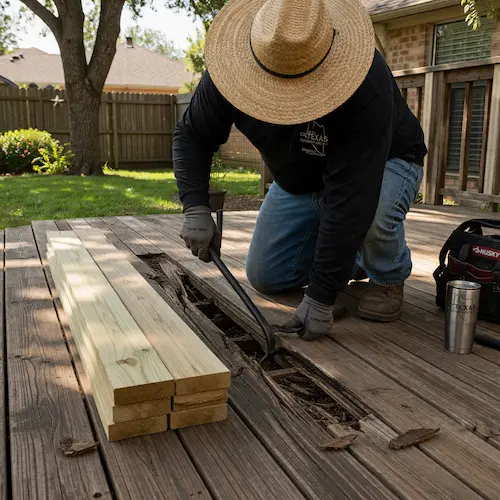
Bad deck boards don’t just look rough — they create tripping hazards, invite moisture into your framing, and get worse every season you leave them. We replace damaged boards cleanly and efficiently, matching your existing deck material as closely as possible so the finished result looks intentional, not patched.
Get a Free Board Replacement Estimate
Tell us about your deck and we’ll get back to you with a clear price. No obligation.
 Before & After
You Don’t Have to Replace the Whole Deck to Fix the Problem
When a handful of boards go bad, the rest of the deck doesn’t need to come with them. Selective board replacement is one of the most cost-effective repairs we do. We pull out the damaged boards, check the framing underneath to make sure there’s nothing being hidden by the bad wood, and install new boards that match your existing material as closely as possible.
The result is a deck surface that’s safe to walk on, looks significantly cleaner, and doesn’t have the warning signs of a bigger problem quietly getting worse under your feet. We always check what’s below the surface boards before we button anything back up — it takes a few extra minutes and has saved more than a few homeowners from a much larger repair down the road.
- Partial or full surface board replacement — whatever the deck needs
- Framing checked underneath every removed board
- Wood and composite board replacement both handled
- Old boards and debris cleared before we leave
Signs Your Deck Boards Need Replacing
Some board damage is obvious. Some of it hides until you step on the wrong spot. Here are the most common things we find when we assess a deck surface in Waco.
Soft Spots or Spongy Feel
If a board flexes unusually or feels soft when you press down on it, the wood fibers underneath have broken down from moisture. This is rot, and it won’t get better on its own — it will spread to adjacent boards and potentially into the framing if left alone.
Cracking and Splitting
Surface cracks that run along the grain are a normal sign of weathering in Texas heat. But cracks that are deep, that span the width of the board, or that create raised splinter edges are a problem. They trap water, worsen with each freeze-thaw cycle, and become a snagging hazard for bare feet and pets.
Warping and Cupping
Boards that have cupped, bowed, or twisted have lost their structural integrity and can no longer be secured flat. They create an uneven walking surface, gaps that let water pool in the wrong places, and fastener problems as the wood works against the screws or nails holding it down.
Visible Discoloration or Dark Staining
Grey weathering is cosmetic. Dark brown or black staining in the wood grain, especially near fasteners or at the ends of boards, usually indicates that moisture has penetrated and the early stages of rot or mold are underway. These boards are worth pulling to check what’s happening underneath.
Fasteners Backing Out
When nails or screws start popping up above the board surface, it usually means the wood underneath has expanded and contracted enough times to lose its grip on the fastener. This is a surface hazard and also a sign that the board has gone through too many moisture cycles to hold properly anymore.
Boards with Insect Damage
Termites and carpenter ants are common in central Texas and both cause structural damage inside deck boards that isn’t visible from the surface. If you notice small holes, sawdust-like frass around your deck, or boards that feel hollow, have them assessed before the infestation spreads to the framing.
How We Handle Board Replacement
A board replacement job done right takes more than pulling out the bad wood and screwing in new pieces. Here’s what our process looks like from start to finish.
Free Assessment
We walk the entire deck surface, probe suspect boards, and identify everything that needs attention. No charge for this visit.
Written Estimate
We tell you exactly which boards we recommend replacing, why, and what the total cost will be. You decide what to approve.
Removal & Framing Check
Damaged boards come out carefully. Before new boards go in, we check the joists and framing underneath and address anything that needs attention.
New Boards In, Site Clean
New boards go in properly fastened and spaced. We clean up all debris and walk the finished work with you before leaving.
Deck Board Replacement in Waco — What to Expect
Board replacement is the most common service we do, and it’s also the one where doing it properly matters most in terms of protecting the structure underneath. The boards you walk on are the first line of defense against moisture reaching the framing. When they fail, the framing is next — and framing repairs cost significantly more than board replacement.
In Waco and central Texas, deck boards take a real beating. Summers are long and hot, UV exposure is intense, and the humidity cycles are unpredictable. Wood boards that aren’t properly sealed and maintained will start deteriorating within a few seasons. Composite boards hold up better to moisture, but they’re not immune to fastener failure, surface damage, or the structural problems that can develop in the wood framing underneath them.
Wood vs. Composite — What We Recommend
If you’re replacing a significant portion of your deck surface, it’s worth having a conversation about materials. Pressure-treated pine is the most common and least expensive option. It works well, it’s readily available, and it takes stain reliably. Cedar and redwood are better at natural rot resistance but cost more. For a partial replacement on an existing wood deck, we’ll match whatever’s already there as closely as possible.
Composite decking costs more upfront but requires less maintenance over time. If you’re replacing most of a large deck surface and want something lower maintenance for the Texas climate, composite is worth considering. The caveat is that the framing underneath still needs to be maintained — composite boards sit on wood joists just like wood decking does, and those joists are equally susceptible to moisture damage.
We’ll give you an honest recommendation based on your specific situation — the condition of your existing deck, your budget, and how much maintenance you want to deal with going forward. We’re not tied to selling a particular product, so the recommendation we give you is based on what actually makes sense for your deck.
What Happens Under the Boards
Every board we remove gives us a view of what’s happening in the framing below. This is a significant advantage of doing targeted replacement work rather than just slapping boards over existing problems. We look at the top surface of the joists — that’s where moisture tends to accumulate and where rot begins. We check the fastener connections between joists and beams. We look for signs of insect activity. If we find anything, we tell you about it before we close the deck surface back up.
In many cases, a board replacement job catches early framing issues that would have gone unnoticed for another season or two. Addressing them at this stage — while everything is already open — is far less disruptive and less expensive than coming back later after the damage has progressed.
Matching New Boards to Existing Decking
New boards will look different from weathered existing boards initially, and it’s worth setting that expectation upfront. Fresh pressure-treated lumber is noticeably lighter than boards that have been exposed for a few years. The gap closes over time with weathering, and it disappears almost entirely if the deck is stained or sealed as part of the project. If aesthetic uniformity is a priority, we’d recommend including a cleaning and stain in the scope — it brings everything to a consistent appearance and adds protection at the same time.
For composite decking, matching depends on the brand and product line. If your composite product is still in production, we can typically source matching boards. If it’s been discontinued, we’ll discuss the options with you honestly — sometimes a close match is possible, sometimes the best path is replacing a larger section to create a clean visual boundary.
Serving Waco and Surrounding Areas
We handle deck board replacement throughout Waco and the surrounding communities including Woodway, Hewitt, Lorena, Bellmead, Lacy Lakeview, Robinson, McGregor, and broader McLennan County. If you’re not sure whether we cover your location, reach out and ask.
Bad Boards Are a Fixable Problem
Don’t let a few damaged boards turn into a framing repair. We’ll come out, assess what needs replacing, and give you a written estimate at no charge. Most board replacement jobs are completed in a single day.
Deck Board Replacement — Common Questions
Things Waco homeowners ask us about board replacement before booking.
We can replace as few or as many boards as the deck needs. Selective replacement is the most common approach — we pull the bad ones and leave the healthy boards in place. There’s no rule that says you have to do all of them. If only three boards are damaged, we replace three boards.
We source material as close to your existing deck as possible. New wood boards will look lighter than weathered boards initially, but they blend in over time. If matching appearance is important to you, adding a cleaning and stain to the project is the most effective way to bring everything to a uniform look immediately. For composite decking, matching depends on whether your product line is still available.
Most selective board replacement jobs are finished in a single day. Larger replacements covering most of the deck surface may take two days. If staining is included, add time for drying between coats. We’ll give you a realistic timeline with your estimate.
We check the framing underneath every board we remove. If we find damage, we stop and talk to you before proceeding. We’ll show you what we found, explain what it means, and give you an updated estimate that includes the framing repair. We don’t close the deck back up over a problem without telling you about it first.
For wood decking, yes — a stain or sealant protects the new boards from the Texas sun and humidity and significantly extends their life. We can handle refinishing as part of the same project. New pressure-treated lumber should typically be allowed to dry for a few weeks before staining, though some products are ready sooner. We’ll advise you on timing based on the specific material used.
Deck Board Replacement Across Waco and McLennan County
We serve Waco and the surrounding area for all deck board replacement work — residential and commercial. Our crew covers Woodway, Hewitt, Lorena, Bellmead, Lacy Lakeview, Robinson, McGregor, China Spring, and the broader McLennan County region.
Get Your Free Estimate
Fill this out and we’ll follow up to schedule a free on-site assessment. No obligation.